#31 Perfect Balance (grades K-12)
Regular price $23.95
Click here for a complete list of materials and convenient shopping.
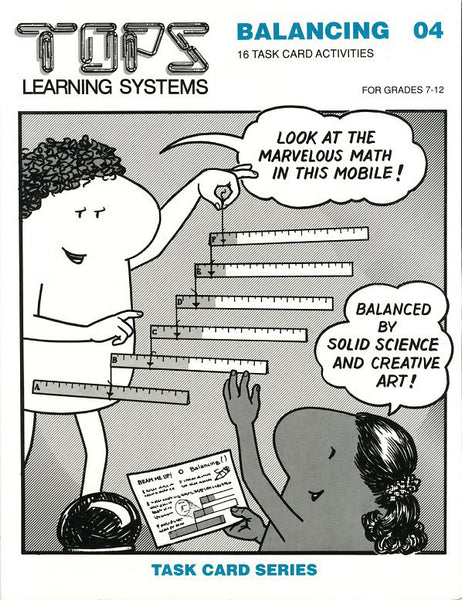
scissors, clear tape, masking tape, clothespins, straight pins, pop-top soda cans with attached finger tabs, paper clips, cups sand, modeling clay, index cards, thumbtacks, pinto beans, popcorn, lentils and long-grained rice, calculators, margarine tub- Lesson 1: To fold a paper beam that will be used in a math balance. To read and follow directions carefully.
- Lesson 2: To complete assembly of the math balance. To read and follow directions carefully.
- Lesson 3: To get acquainted with a math beam. To diagram various ways that paper clips balance on the beam.
- Lesson 4: To understand that paper clips add up to equal sums on each arm of a balanced beam.
- Lesson 5: To understand that paper clips multiply to equal products on each arm of a balanced beam.
- Lesson 6: To gain further experience with balance beams and the mathematics of balancing.
- Lesson 7: To practice expressing complex balance conditions as mathematical equations.
- Lesson 8: To mathematically predict and then verify a state of balance or imbalance in a math beam.
- Lesson 9: To mathematically predict and then verify the tilt of a math beam.
- Lesson 10: To recognize that the mathematical properties of an equal-arm balance can be extended to a balance with unequal arms.
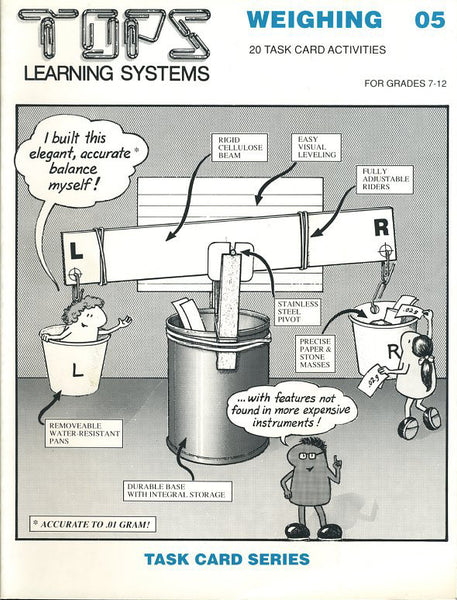
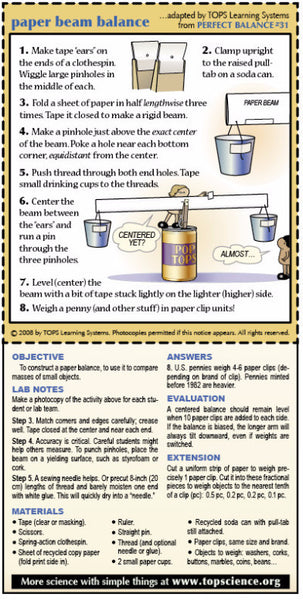
- Lesson 11: To construct a paper beam to use in a weighing balance. To read and follow directions carefully.
- Lesson 12: To complete construction of the weighing balance. To read and follow directions carefully.
- Lesson 13: To make weight comparisons on a balance and thereby generate simple mathematical relationships.
- Lesson 14: To weigh common objects using a paper clip weight standard.
- Lesson 15: To develop and use a system of weight measure that's accurate to a tenth of a paper clip. To read and follow directions carefully.
- Lesson 16: To develop a weighing system based on paper squares. To multiply by a unit conversion factor that changes paper-clip weight measure to paper-squares, and confirm this calculation by experiment.
- Lesson 17: To weigh individual pinto beans in paper squares and graph a distribution profile.
- Lesson 18: To discover that weight and area increase and decrease proportionally in materials of uniform thickness.
- Lesson 19: To "count" an unknown quantity of paper clips by comparing their weight to a known number of paper clips on a balance.
- Lesson 20: To graph how the force required to balance an off-center beam increases as it is applied closer to the pivot.
This book presents great opportunities for cross-age teaching. Arrange for your most capable older students to take their balances and unmarked activity sheets into a lower grade and mentor younger children one-on-one.
As with many TOPS units, these activities give helpful practice in reading and following directions, thus encouraging independent study. Physical results give almost instant feedback, and quick success builds student focus, confidence and enthusiasm. Perfect Balance is a particularly good subject for students for whom English is not their native language.
Keep a couple of balances available in a corner workstation for students who finish tests early, or for constructive activity on rainy days. Consider extra credit for students who construct new math challenges for others to solve with the balances.
Because the constructed balance beams can easily be sent home upon completion of class activity, students can have fun inventing their own independent extension activities.
NOTE: We encourage improvisation - it's one of the main goals of our hands-on approach! You and your students might invent a simpler, sturdier or more accurate system; might ask a better question; might design a better extension. Hooray for ingenuity! When this occurs, we'd love to hear about it and share it with other educators.
TEACHING Standards
These 20 Activity Sheets promote excellence in science teaching by these NSES criteria:
Teachers of science...
A: ...plan an inquiry-based science program. (p. 30)
B: ...guide and facilitate learning. (p. 32)
C: ...engage in ongoing assessment of their teaching and of student learning. (p. 37)
D: ...design and manage learning environments that provide students with the time, space, and resources needed for learning science. (p. 43)
CONTENT Standards
These 20 Activity Sheets contain fundamental content as defined by these NSES guidelines (p. 109).• Represent a central event or phenomenon in the natural world.
• Represent a central scientific idea and organizing principle.
• Have rich explanatory power.
• Guide fruitful investigations.
• Apply to situations and contexts common to everyday experiences.
• Can be linked to meaningful learning experiences.
• Are developmentally appropriate for students at the grade level specified.
Unifying Concepts and Processes
NSES Framework: Systems, order, and organization • Evidence, models and explanation • Constancy, change, and measurement • Evolution and equilibrium • Form and functionCore Concepts/Processes: A math balance is a physical representation of an algebraic equation: The tilt of beam represents equality and inequality. • Force times pivot distance on one side of a balanced beam equals force times distance on the opposite side. • A balancing system is integrative, interconnected, predictable and rational. • A balance beam may be kept in equilibrium with offsetting changes.
Science as Inquiry (content standard A)
NSES Framework: Identify questions that can be answered through scientific investigations. • Design and conduct a scientific investigation. • Use appropriate tools and techniques to gather, analyze, and interpret data. • Develop descriptions, explanations, predictions, and models using evidence. • Think critically and logically to connect evidence and explanations. • Recognize and analyze alternative explanations and predictions. • Communicate scientific procedures and explanations. • Use mathematics in all aspects of scientific inquiry.Core Inquiries: Improvise an equal arm balance for serious inquiry into mass and weight.
Physical Science (content standard B)
NSES Framework: Position and motion of objects • Properties and changes of properties in matter • Motions and forces • Conservation of mass. Core Content: Explore the physics of math balances. • Build equal-arm balances and develop a series of masses accurate to 0.01 grams. • Experiment with different weighing units.
Science and Technology (content standard E)
NSES Framework: Abilities of technological design • Understanding about science and technology
Core Content: Build an analog computer (a math balance). • Construct a gram balance sensitive to 0.01grams. • Invent a system of masses based on paper clips and paper squares.
Science in Personal and Social Perspectives (content standard F)
NSES Framework: Science and technology in local challengesCore Content: Older students teach younger students in a cross-age learning context, experiencing learning from a teaching perspective.